The strongest predictor of what an author earns is not talent, and it is not who published them.
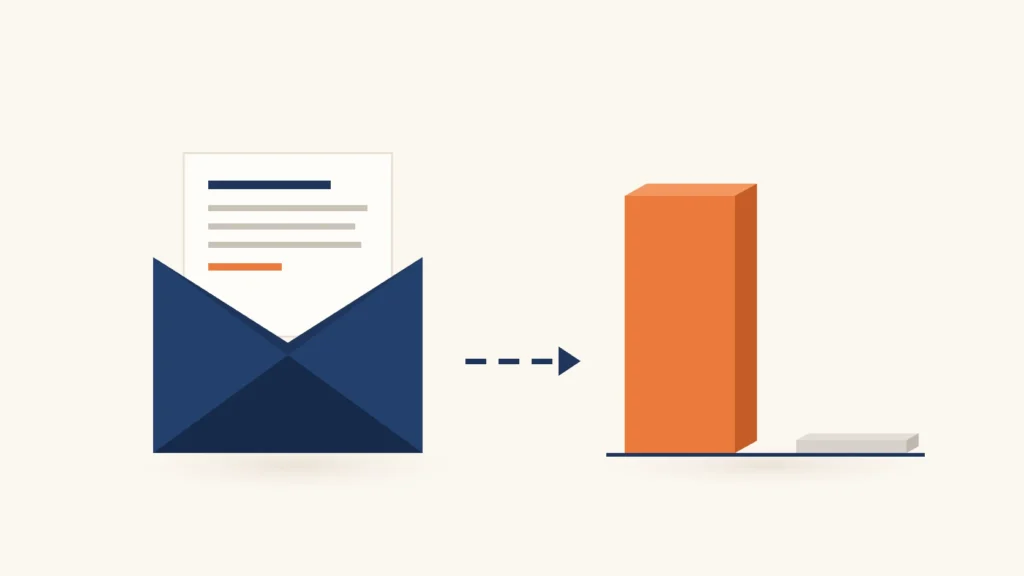
Written Word Media’s 2025 Indie Author Survey collected 1,346 responses from authors. Authors with an email list reported median earnings of about 300 dollars a month. Authors without one reported about 15 dollars a month.
Twenty times, for something that costs nothing to start and does not require a finished manuscript.
The rest of the distribution
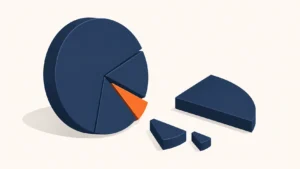
The same survey found that 44 percent of authors earn 100 dollars a month or less from their writing. That is close to half the authors in the sample, and it is the part of the picture that rarely appears in a publishing pitch.
At the other end, authors earning above 10,000 dollars a month averaged 18,327 email subscribers and spent about 4,500 dollars a month on marketing. Further down, among authors earning above 1,000 dollars a month, catalogues of 10 or more books were common.
Read those two facts together and the shape of it becomes clear. The top is not a different kind of writer. It is a writer with an audience they can reach directly and a backlist to sell that audience.
Why nobody tells you this
Nobody sells you an email list. There is no invoice line for it, no vendor, no package that includes it.
Compare that with everything else on a publishing quote. Editing, cover design, typesetting, ISBN handling, print, distribution setup. Every one of those is something a company can charge you for, and so every one of those gets explained to you in detail.
The single variable most associated with earnings in this survey is the one thing in the process nobody can bill you for. That is probably the whole explanation for why it goes unmentioned.
Start it before the book is finished
The instinct is to wait. Finish the manuscript, get the cover, launch, then start collecting readers.
That order gets it backwards. On launch day you need people who already want the book. Collecting them starts months earlier, and the writing period is when you have the most natural reasons to talk to people: a chapter you are wrestling with, research that surprised you, a decision about the ending.
Ten people who asked to hear from you are worth more on launch day than a thousand who scrolled past a post. The ten will open the email. Most of them will look at the book. Some will buy it in the first week, which is the week that matters for every algorithm you are about to be judged by.
What a list actually needs to be
It does not need to be a marketing operation. It needs to be three things.
Somewhere for a name to go. A simple sign-up form. Any of the standard email tools will do this on a free tier at the scale you are starting from.
A reason to sign up. A sample chapter, early access, notification when the book is out. Something specific enough to answer the question of what the person gets.
Contact often enough to be remembered. Once a month is enough. A list that hears from you twice in two years is not a list, it is a spreadsheet of strangers.
The uncomfortable version of this
Most first-time authors will spend more on a cover than they will ever earn from the book. That is not an argument against a good cover. A good cover matters.
It is an argument about sequence. The cover works on people who see it. The list determines how many people see it in the first place, and whether anyone is waiting when the book goes live.
If you are writing something now and have not started collecting names, that is the one thing worth fixing this month. It costs nothing, it does not wait on your manuscript, and on the evidence of 1,346 authors it is the variable most closely tied to what you eventually earn.
Related reading
Once you have readers waiting, the pricing decision matters: see why the 70 percent KDP royalty is not 70 percent in India. If you are still at the paperwork stage, start with the free ISBN route. Writing in Kannada? Read how to get a Kannada book onto Amazon. Our publishing packages are set out on the site.